Blog of Cawthra Dental
Pros and Cons of Removable and Fixed Retainers
Retainers are used to hold teeth in a certain place, often after orthodontic work is completed. After orthodontics, if no retainer is used, the teeth may shift and revert to the position they started in. Your dentist or orthodontist will recommend either a removable or a fixed retainer to keep your smile looking aligned.
Removable Retainer
With this type of retainer, you can put in and take out when needed. It is recommended to wear your retainer as much as possible. The exception being when eating and brushing or flossing. Sometimes they are only recommended for night-time use. Make sure you discuss with your dentist or orthodontist about the recommended usage. Removable retainers will either be a clear tray or have a wire front depending on what the use.
Advantages of Removable Retainers
The advantage of a removable retainer is that you can take it out and put it back in. This means that it is much easier to brush and floss your teeth, and you can take it out of your mouth when needed.
Cons of Removable Retainers
For the retainer to work, you have to wear it. If a patient isn’t compliant with wearing their retainer for the recommended amount of time, their teeth may be more susceptible to shifting with time. If you don’t wear your retainer consistently, sometimes it can feel tight or sore when putting it back in.
Fixed Retainer
A fixed retainer is a wire that is glued to the back of your front teeth (either bottom, top or both) to hold your teeth in place and prevent shifting. Fixed retainers stay in place without having to be taken out and put back in.
Advantages of Fixed Retainers
The benefit of a fixed retainer is permanent retention. Because the fixed retainer can stay in for eating, brushing and flossing, it is continually holding the teeth in the correct position.
Cons of Fixed Retainers
Because the fixed retainer cannot be removed, it cannot be taken out for brushing and flossing. The wire causes difficulties with cleaning as there are more areas where plaque and bacteria can build up. There is more work involved in keeping your teeth clean when you have fixed retainers. Floss threaders, super-floss and even a water flosser, are important tools to use to help you clean your teeth clean.
Can Sparking Water Harm your Teeth?
We all know that sugar intake affects our teeth and can lead to tooth decay, but did you know that the PH level can also change the risk to teeth? The PH level is how acidic or basic something is that we are eating or drinking. Sparkling water is thought to be more acidic than flat water because of the added carbonation.
The Study
Extracted teeth that were donated were used for the study, which tested the effect of sparkling water vs. flat water. Teeth were submerged for some time in both types of water, and the result? Sparking water appeared to have no adverse effect on the teeth, much like flat water.
It appears that sipping on sparkling water throughout the day will not lead to cavities or enamel erosion. But be aware, any sparking water with additives like citrus may have a more damaging effect on the teeth as the acidity level will be higher. Also, the best way to have your sparkling water would be in a machine where you can make it at home, because the use of tap water will incorporate fluoride into the sparkling water, giving you that added anti-cavity protection.
What Not to Drink
Any drinks containing sugar or high acidity levels are not going to be good for your teeth. This means soda, fruit juices with added sugar and even natural juice with natural sugar all have a cavity-causing effect on the teeth.
Frequency Vs. Quantity
Think about it this way; the frequency in which you consume sugary or acidic drinks is the most crucial factor in cavity risk. If you have a small glass of orange juice, but you sip it slowly over the course of a few hours, the exposure to sugars will actually be greater than gulping back a sugary soda all at once (although not good for your health!). The exposure time is an important factor in cavity risk.
How To Deal With Sensitive Teeth
Sensitive teeth can be a daily nuisance, and sometimes it’s not clear what is causing the sensitivity. It is essential to find the root cause of the sensitivity and eliminate it. Thankfully, there are several options for reducing symptoms of sensitive teeth.
Sensitivity Toothpaste
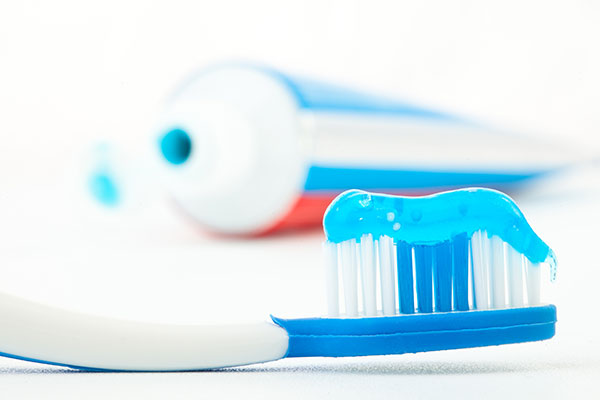
Sensitivity toothpaste helps to reduce the symptoms of sensitivity by applying a thin protective layer on the teeth. This protective layer helps block microscopic tubules that lead from the outer part to the inner part of the teeth. Sensitivity toothpaste can provide instantaneous and long-lasting sensitivity relief.
Desensitizer
A desensitizer acts in a similar way to sensitivity toothpaste by blocking microscopic tubules to prevent sensitivity. When you consume anything that may cause sensitivity, the sensation cannot enter the underlying tooth structure to cause sensitivity. Desensitizer has to be applied in office by a dental professional and usually lasts several months.
Reducing Sweets/Acids in Your Diet
A great way to prevent sensitivity is to consume fewer sweets and acids in your diet. These types of foods can lead to cavities and erosion on your teeth, creating sensitivity.
Use a Soft/ Electric Toothbrush
Sensitivity can be caused by aggressive brushing, or by use of a toothbrush that is too hard on your teeth and gums. Aggressive brushing and hard toothbrushes can lead to recession of the gums and abrasion of the teeth. Try using an electric toothbrush with a pressure indicator or an extra soft or soft toothbrush.
Dental Fillings
Dental fillings can be used to fill in areas of recession and wear to prevent sensitivity. If sensitivity is caused by gum recession, a thin layer of filling material can be placed to protect from external stimuli. Sensitivity due to wear can be treated with dental filling material.
What Is Invisalign and How Could it Benefit You?
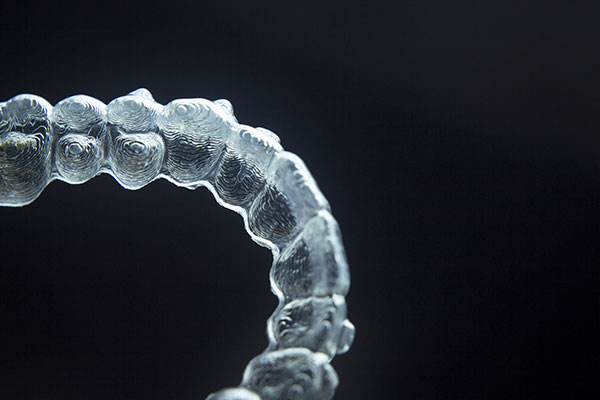
Invisalign is a form of orthodontic treatment that involves a series of clear plastic aligners that slowly straighten your teeth and improves your bite. Invisalign works by using aligner trays to move your teeth slowly and effectively. The aligner trays are secured to teeth through the use of attachments that are bonded to the teeth. Attachments are small pieces of plastic resin that get bonded on the front surface of several of your teeth. But don’t worry; the attachments are tooth coloured and difficult to see. The length of treatment and the cost of the Invisalign will depend significantly on the work to be done. Your specific treatment plan will be discussed with you before treatment. As well, you will be able to ask any questions you have.
How is Invisalign Made?
Before you start your treatment, you will see your dentist or orthodontist to have impressions taken of your teeth. These impressions will be sent to the Invisalign lab, which will then create a detailed, custom, digital treatment plan and a series of Invisalign aligner trays. The number of trays in your treatment plan is based on how much work and movement is needed. You will see your Invisalign trained dentist or orthodontist every 4-6 weeks to assess results and to get more trays. You will be instructed on how frequently to change your trays. Usually, it is every 1-2 weeks.
Important Invisalign Facts
- It is essential to maintain excellent oral hygiene during your Invisalign treatment. Make sure to brush at least twice and day and floss at least once a day. The most beneficial practice is to always brush after eating and before putting your trays back in.
- Use a fluoride toothpaste and mouthwash to prevent cavities during your Invisalign treatment.
- Wear your trays at least 20-22 hours a day, try only to take them out when eating, drinking and cleaning your teeth.
- Clean your Invisalign trays with a separate toothbrush and warm water. Never use hot water on your Invisalign trays as it could warp them.
- Invisalign is an excellent option for most cases, including if you’ve already had braces before and notice some shifting.
- Aligners are made of a select type of thermoplastic material explicitly created for Invisalign.
Learn Why Baby Teeth Are Important
They Aid in Chewing, Biting, Talking and Smiling
Baby teeth, most importantly, are used for everyday function. A full set of baby teeth are an essential component in biting and chewing, in forming the correct sounds for speech, and for confidence in smiling. If a baby tooth is lost prematurely, it can make any number of these essential functions more difficult. If biting and chewing are difficult, there is a risk of inadequate nutrition. If talking and smiling are difficult, it can result in problems with socialization and self-confidence.
Hold the Place for the Adult Teeth
The adult teeth use the baby teeth as precursors when they begin to erupt. The adult teeth find their place by resorbing the root of the baby tooth above them and erupting in the same position. If the baby tooth is lost prematurely, to a cavity/infection or trauma, there will be no precursor for the adult tooth to follow for the eruption. And the likelihood of erupting out of position will be higher, leading to difficulty with cleaning and possibly the need for future braces.

Affect the Health of the Adult Teeth
If there is trauma or infection with a baby tooth, it can lead to problems with the future adult tooth. Injury can cause the root of the baby tooth to hit the vulnerable, forming adult tooth and affect the development, sometimes leading to a discoloured area when it eventually erupts. A large cavity that turns into an infection can have similar results, as the infection can travel up the root of the baby tooth and affect the space the adult tooth is forming in.
Proper Speech and Facial Development
Baby teeth are needed for proper speech and facial development. If baby teeth are lost premature, there could be delays or issues with the development of the face and jaw and the ability to create proper sounds for speech.
Options To Replace Missing Teeth
If you are missing one or more teeth, it is vital to have them replaced using either a denture, a bridge or an implant for several reasons. Replacing missing teeth restores your mouth to its natural function. You will be able to smile, talk, bite and eat with confidence. But what you might not be aware of is that missing teeth can lead to changes in the shape of the jaw and cheeks by creating concavities. Missing teeth can also lead to shrinking of the jawbone in affected areas because there are no longer teeth to support the height of the bone. There are several options to replace missing teeth. Your dentist will discuss which option will work best for you.
Partial or Full Denture
Dentures that are used to replace one or more teeth are called a partial denture. A full denture replaces an entire arch of teeth. A denture attaches to either the top and or bottom of the mouth to fill the space of the missing teeth. Dentures can help with aesthetics and eating but are not the most comfortable, convenient or long-term solution.
Dental Bridge
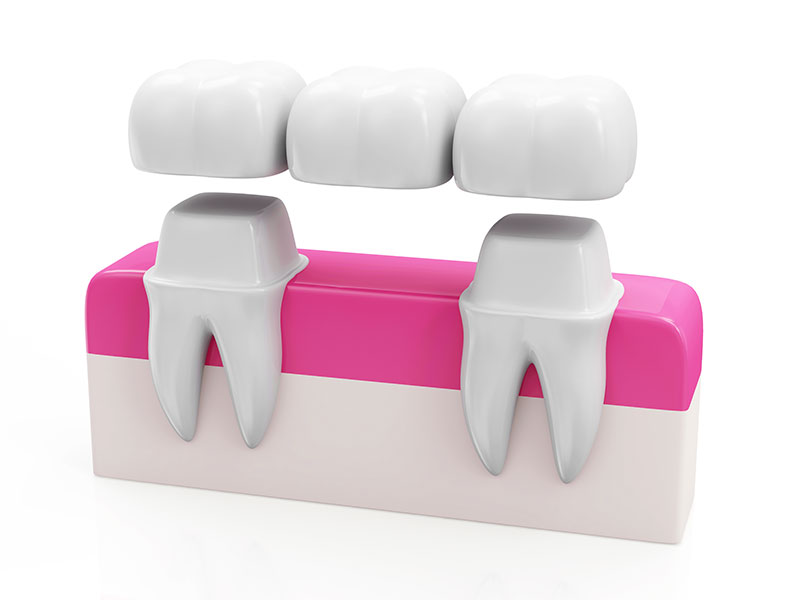
A dental bridge is an excellent solution for replacing just one tooth, or sometimes two teeth side by side. A bridge consists of the pontic tooth or teeth which are the fake teeth used to close the space, which is attached to crowns on either side of the pontic(s). The downside to a dental bridge is that the adjacent teeth on either side must have crowns placed to support the pontic, even if they are healthy teeth.
Dental Implants & Implant-Supported Dentures
The gold standard in tooth replacement is now dental implants. Dental implants are the best option to feel, look and function just like a natural tooth. You don’t need to sacrifice the adjacent teeth for an implant, and an implant helps to save the bone where the tooth was lost. A dental implant consists of a titanium screw that is inserted into the bone. Once placed, a porcelain crown is secured to the top of the dental implant. When taken care of properly, implants can last a lifetime. Implants can also be used to replace a full arch of teeth by supporting dentures that don’t need to be taken out and put back in every day.
Helpful Tips When Brushing Your Child’s Teeth
The first baby teeth to erupt in your child’s mouth are the lower front two teeth, which will erupt around 6-10 months old. As soon as your child has a tooth, it is essential to use a toothbrush to keep it free of bacteria. Before teeth erupt, you can use a damp cloth or gauze to wipe your baby’s mouth after they’ve had milk and before bed. Brushing your child’s teeth may be difficult at first, but gets easier with time.
Brushing your Baby’s Teeth
It is essential to get into the habit of cleaning your baby’s mouth as soon as possible to get them used to the experience. Some babies will be comfortable with this experience from the beginning, and some will cry and put up a fight. If your baby is upset while having their mouth cleaned, try laying them on the bathroom floor after bath time, with their head in your lap, and use one hand with the toothbrush and the other hand to hold their hands away from their mouth. Try the best you can to access all teeth with the toothbrush. As the child gets older, this experience will be more natural. Begin using a fluoridated toothpaste around the age of 3 with only a grain of rice size amount on the toothbrush head. Fluoridated toothpaste helps to prevent cavities. Flossing is also an essential part of the regimen as soon as any teeth contact each other. Usually, the first teeth to touch will be in the back, and these are the most susceptible teeth to in-between cavities.
Checking your Child’s Brushing
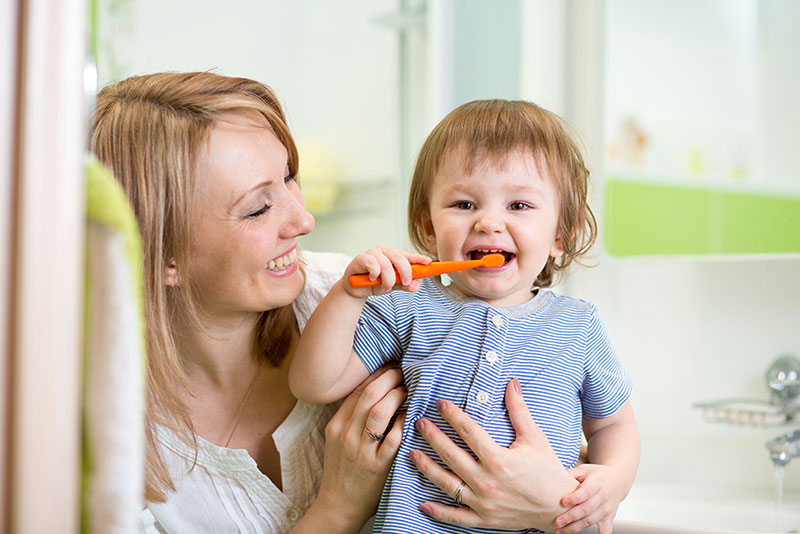
It is recommended to help your child brush/ check their brushing until the age of 8. Below eight years old, their hand dexterity and understanding of the importance of brushing might be lacking and if left unchecked, might lead to gum issues and cavities.
Tools to Help your Child Brush
There are many aids to help your child brush adequately and for the full 2 minutes. Some toothbrushes play a song for 2 minutes, so your child knows to continue brushing until the song is over. Some toothbrushes will give a beep at the end of the 2 minutes. Another option is a sand timer that your child flips as soon as they start brushing, and can stop once all the sand has gone through. It is crucial that your child feels comfortable with the toothbrush they are using and the flavour of the toothpaste so that they enjoy brush time.
Learn About Different Tooth Cleaning Aids To Keep Your Mouth Healthy
Walking into a drug store, it can be overwhelming trying to pick from the vast array of products on the shelf and what will work best for your mouth based on your individual needs. Below are listed many of the products you may find at the store, and what they are used for.
Manual Toothbrush- Manual toothbrushes come in super soft, soft, medium and hard. Super soft toothbrushes are recommended for patients with recession or patients that scrub too aggressively, to preserve the gum line. Soft toothbrushes are the most commonly recommended, and medium and hard are just too abrasive on the gums, don’t use them!
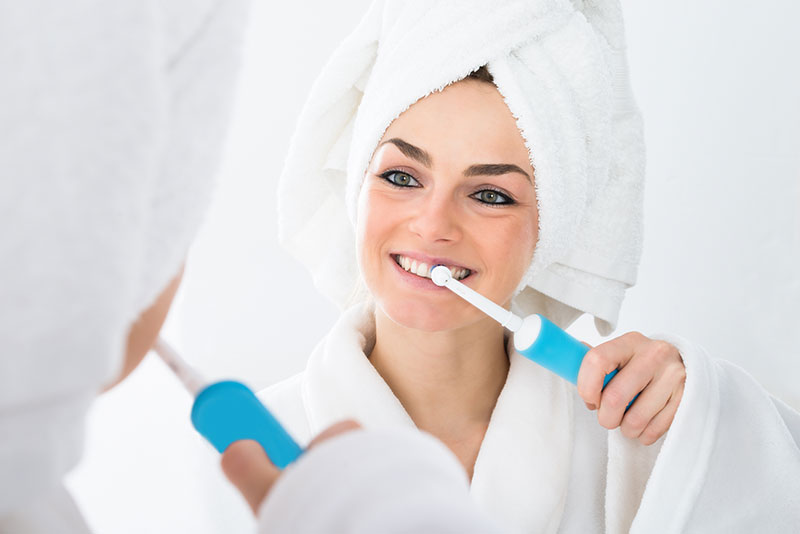
Electric Toothbrush- Electric toothbrushes often do an excellent cleaning job when compared to a manual toothbrush. Electric toothbrushes either come in a circular or oval head shape, and either use an oscillating or sweeping motion. Electric toothbrushes can achieve more brush strokes in a minute than a human hand and are therefore considered to be a superior clean if appropriately used.
Floss- Floss comes in either waxed or un-waxed. Waxed floss is excellent for tighter contacts between teeth that may shred the floss and is known to be easier to use. Un-waxed floss can absorb more bacteria than waxed floss but is more prone to shredding and tearing.
Floss Wands- Floss wands are a great alternative to manual floss for patients who find flossing challenging. Floss wands contain a pre-cut piece of floss on a handle. Floss wands can be either disposable or reusable depending on the type. They are great for kids and patients with lower skill.
Water Floss- Water floss is an electric tool that sprays water in a jet stream to clean out bacteria from difficult to reach spots. Water floss is highly recommended for a patient with braces or with deep gum recession.
Tongue Scraper- Tongue scrapers are used to remove the bacteria accumulation on the surface of the tongue. Because the surface of the tongue is uneven from microscopic taste buds, bacteria can quickly accumulate. A tongue scraper uses a corrugated edge to clean the bacteria out.
Sulcabrush- This brush has a small end of bristles, about 1/3 the size of a regular manual toothbrush. It is used to clean out areas that are difficult for a large brush head to access, such as around back molars or gum loss between teeth.
Proxabrush- A proxabrush is a small pipe cleaner looking brush that is used to clean around the brackets and bands of braces as well as in between teeth.
Rubber Tip Stimulator- This tool is used to promote good blood flow to the gums and reduce gum inflammation. The rubber tip is used to apply light pressure to the gums.
It is essential to discuss with your dentist/ dental hygienist what products will work best for your individual needs. If you have any questions about any dental product or how to use them, we encourage you to contact us today to schedule an appointment.
5 Benefits of Dental Implants
Dental implants are the gold standard for replacing missing teeth. Advancements in the dental industry over the last 20 years have created options for patients missing teeth; we are no longer living in the age of dentures, although dentures are still a viable option. Whether a patient is missing 1 or all of their teeth, dental implants are the best option to replace them and give the patient back proper function and aesthetics. A dental implant is a titanium screw that is inserted into the bone where the gap is, that then has a dental crown placed on top. The screw takes several months to integrate into the bone before the crown can be placed and it can withstand force. Listed below are five benefits of dental implants:
Functions Just Like A Natural Tooth
Once an implant is placed, integrated into the bone and the dental crown is placed on top, it functions the same as a natural tooth. You don’t have to worry about taking anything out or putting it in. A dental implant is used for biting and chewing just like a natural tooth. A dental implant also gets cleaned like a natural tooth, with brushing and flossing to prevent bacteria build up.
Aesthetically Pleasing
Dental implants are by far the most superior aesthetic for replacing missing teeth. Dental implants use crowns on top that are fabricated in a lab to match inside a patient’s mouth. The colour, shape, and size can all be determined before the crown is even made.
Can Last A Lifetime
Dental implants can last a lifetime if properly cared for. That means adequate brushing, flossing and dental cleanings/ check-ups to monitor the health of the implant and surrounding teeth.

Saves Surrounding Teeth
If a gap is left from a missing tooth, oftentimes the opposing teeth will over erupt and the adjacent teeth will drift forward to fill the space. It is important to address a gap before surrounding teeth start to shift to prevent extra work/procedures. In addition, bone in the jaw will resorb away from an area without a tooth, so the sooner an implant is placed after a tooth is lost, the better.
Can Be Used for The Entire Mouth
A dental implant can be used to replace 1 missing tooth or an entire arch of missing teeth. Several implants can be placed along the arch of missing teeth and an implant supported denture can be placed on top. This type of denture is fixed, meaning it doesn’t require removal and insertion and prevents a patient from having to deal with the difficulties of removable dentures.
What is a Root Canal and When is it Needed?
What is a Root Canal?
A “root canal” actually refers to the anatomy of a tooth. A tooth is like an iceberg, there is a crown on top that comprises about 1/3 of the tooth length, and the root portion below that comprises the remaining 2/3. Inside the root is a canal that houses the blood supply and nerves of the tooth, which is called the pulp. Essentially, this pulp is what keeps the tooth vital and in good health. It is within this canal that infection can occur. A root canal treatment is recommended to save a compromised tooth from needing extraction, which can happen when the pulp is damaged, and bacteria enter. A tooth can still be functional after the pulp is removed for a root canal treatment, but will lack some sensory effects such as hot and cold sensitivity.
When a Root Canal Treatment is Needed
Several factors dictate the need for a root canal treatment including deep cavities that enter the nerve, trauma to the tooth, chips/fractures or repeated restorative dental work. Often an infected root canal will have symptoms. These symptoms can range from mild cold or hot sensitivity to unbearable throbbing pain. Also, the presence of an infection is common in the form of an abscess. An abscess occurs when the infection from the tooth causes pus to pool at the bottom of the root. Sometimes there can be a “pimple” on the gum that drains the infection. An abscess can be associated with a bad taste.
The process of a Root Canal Treatment
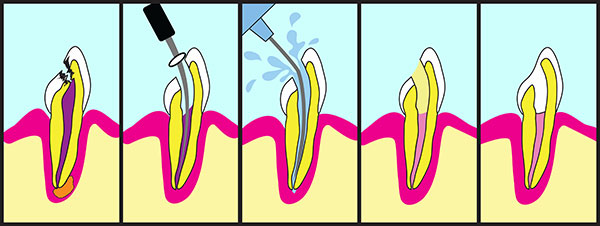
A root canal treatment can take anywhere from 1 to several visits depending on the tooth, size and amount of infection. Molars have more root canals (up to 4 or 5) than front teeth (usually 1.) Either a dentist or an endodontist will perform the procedure depending on the complexity and the difficulty level. If needed, a dentist can refer a patient out to an endodontist. The first step is to take an x-ray of the area to assess the infection. Next, the area will be frozen, and a dental dam will be placed on the tooth to isolate all saliva and bacteria. An access hole will be drilled into the tooth to access the root(s.) The nerve, blood supply and infection will be removed, and the canal will be thoroughly cleaned with files increasing in size. Either on the same day or at a second appointment a week or so later, a filling material will be fitted into the canal(s.) A filling will be placed on top of the canals to seal them off. The last step is the restoration of the crown of the tooth. Usually, a dental crown is recommended to provide support and prevention from chips/fractures.
If you believe you may require a root canal treatment, or have any questions about it, we encourage you to contact us today to schedule an appointment.